Ticket guide
LEGOLAND Florida Annual Pass: When the Clock Starts
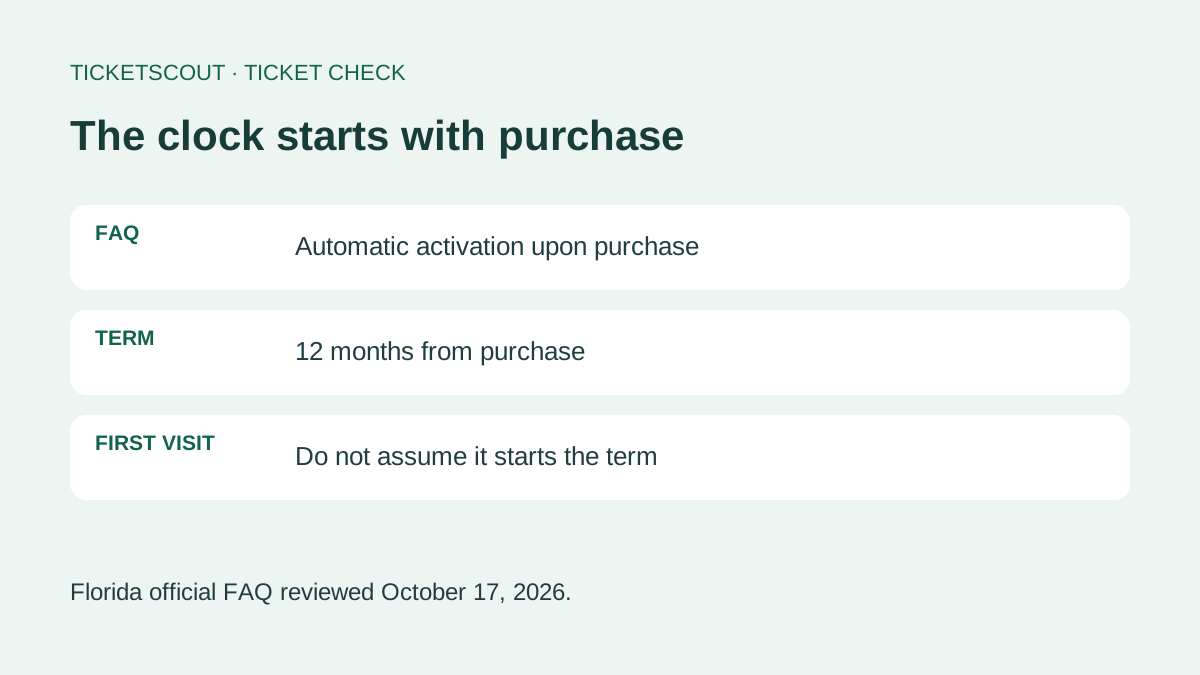
The Florida annual-pass FAQ says a pass activates automatically at purchase and is valid for twelve months from that date. Do not assume the first visit starts the clock. Confirm the exact issued pass’s expiration and tier restrictions before planning later visits.
Checked 2026-10-17 · Florida new-pass planning, not an exact expiry-time calculation or a special-product guarantee.
What the current Florida FAQ says
The official LEGOLAND Florida annual-pass page, reviewed October 17, 2026, states that a pass lasts twelve months from purchase and activates automatically when purchased. Its new-pass terms also place the start at purchase/activation.
The page identifies blockout restrictions for Standard passes and warns that operating dates can change. A pass term therefore does not, on its own, establish access on every date. We have not verified a special delayed-activation product, an exact expiry timestamp, a renewal exception or a pause/refund procedure.
TicketScout's three-date ledger
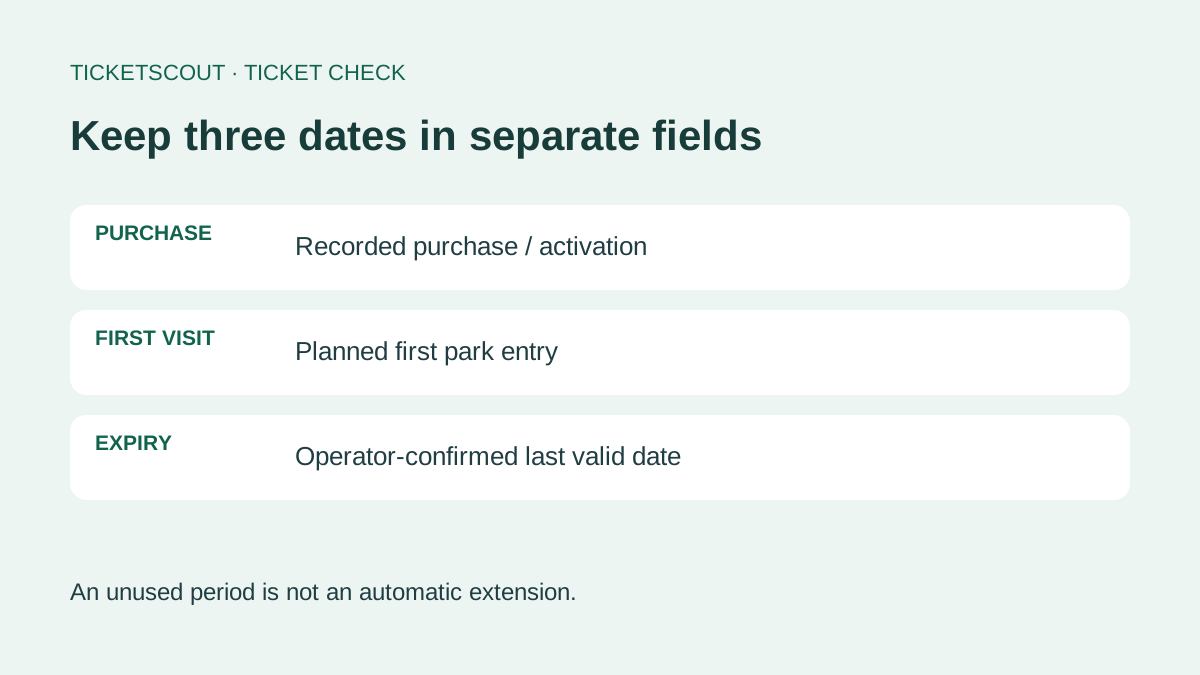
Record the purchase date, the planned first visit and the operator-confirmed expiration separately. Use the actual order confirmation for the first field, your travel plan for the second, and the issued pass or an operator answer for the third. A travel itinerary is not evidence that activation will wait for your arrival. Keeping all three fields visible makes it harder to substitute a hoped-for start date for the start described by the product.
If you have not purchased, leave the first field marked as a proposed purchase date. If you already own a pass, do not replace the actual purchase date with a new planning date. Record the product name and tier alongside the dates so you can identify which terms belong to that pass. We have not established that every promotional or legacy product has identical rules.
Recognize time before the first visit
Consider a hypothetical plan to purchase on October 20 and first visit on December 20. The first visit is later than the purchase. Under a purchase-based activation rule, that waiting interval is not evidence that the clock is paused. This example compares two planning dates; it is not a quote or a calculation of the exact last day of access.
Compare that plan with purchasing closer to the intended visit, but do not assume a later purchase has the same price, availability or benefits. Those are separate inputs that require current product evidence. This guide does not recommend a universally cheapest purchase date or predict a future promotion. Its purpose is to expose the difference between buying earlier and beginning to use the pass earlier.
Build a visit-by-visit coverage table
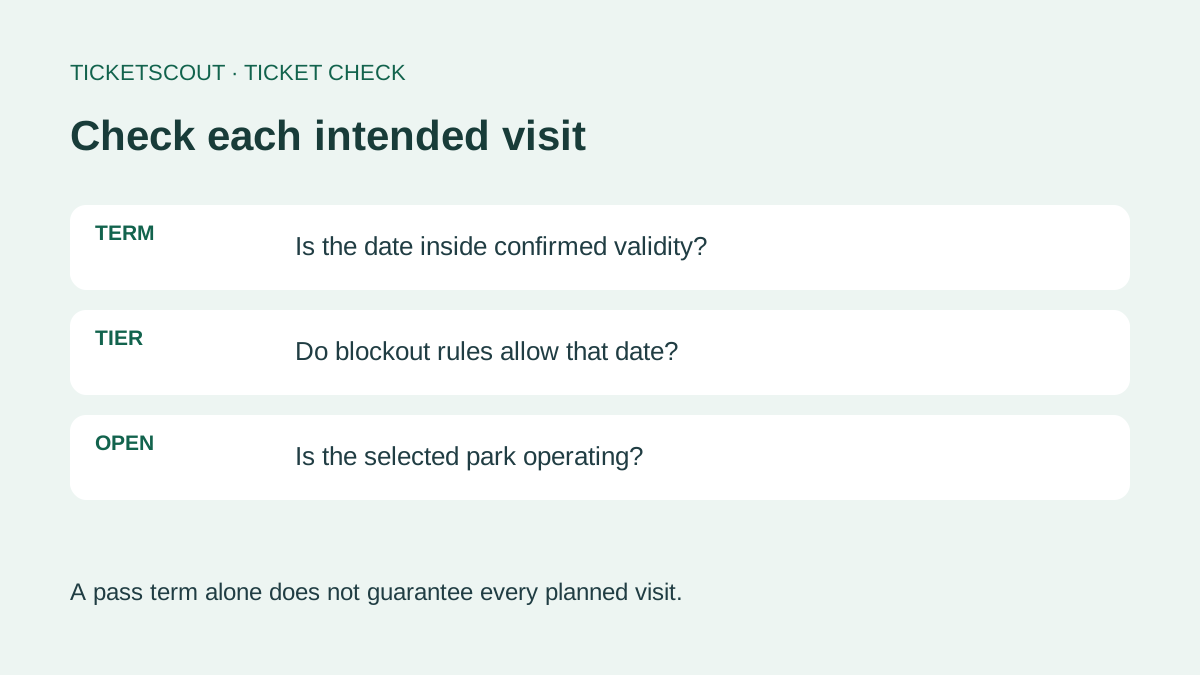
List every intended park date rather than writing only a total number of visits. Give each row three checks: the confirmed pass period, any restrictions for the selected tier, and the park's operating schedule. Leave a row unresolved when one of those checks is missing. A date can be inside the pass period yet still need a separate operating or blockout check.
For trips to more than one attraction, identify the destination in each row. Do not assume that a benefit at another attraction has identical entry conditions or hours. Likewise, do not convert an annual-pass admission entitlement into a guarantee that a specific attraction will operate. This worksheet records whether coverage is evidenced; it does not reserve entry or override capacity restrictions.
Recheck the ledger when a trip moves
If travel is delayed, change the planned visit field and recheck all affected rows. Keep the purchase field unchanged for an existing pass. Ask the operator how any relevant exception or amendment works before relying on it. An unused pass and an unactivated pass are different descriptions when the product activates at purchase.
We have not verified that postponing a trip extends the term, creates a refund right or changes an existing contract. Do not infer any of those outcomes from a lack of park visits. If a special product states a different activation rule, retain that exact wording and obtain confirmation that it applies to the purchased product.
Confirm the final boundary explicitly
A general twelve-month description does not tell this guide the precise last-entry timestamp, treatment of every calendar edge case or whether a displayed expiration date is inclusive. Read the issued pass and ask about the specific date you intend to use. Keep the operator's answer beside the ledger rather than generating a confident last-day promise from an informal date calculation.
For a household, check each pass independently before assuming a shared renewal or expiration date. Purchases made on different days may need separate confirmation. The final read-back is the passholder, exact product, purchase record, confirmed validity and each planned visit. Only then compare alternatives over the dates that they actually cover.
Questions and answers
Does the FAQ say activation waits for the first visit?
No. It describes automatic activation upon purchase.
Does delaying my first visit automatically extend the term?
No such extension was established in the reviewed material. Confirm any exception for the exact purchased product.
Can I use the pass on every date inside the term?
That is not established by the term alone. Check tier restrictions and operating dates separately.
These are independently authored questions based on the official source above. Other topics: Florida parking rights and children's admission age.